
Honesty, Nostalgia, and Sandals
1 | Being open and honest allows for wonderful and unexpected connections
This may be my first post, but I began work on it over a year ago.
Inspired by Om Malik's "Field Notes", I latched onto the idea of posting "three thoughts" regularly.
Unfortunately, the domain name I was thinking of was taken. It wasn't the end of the world. There are many that would work, but this is the one I wanted.
So I sent this email:
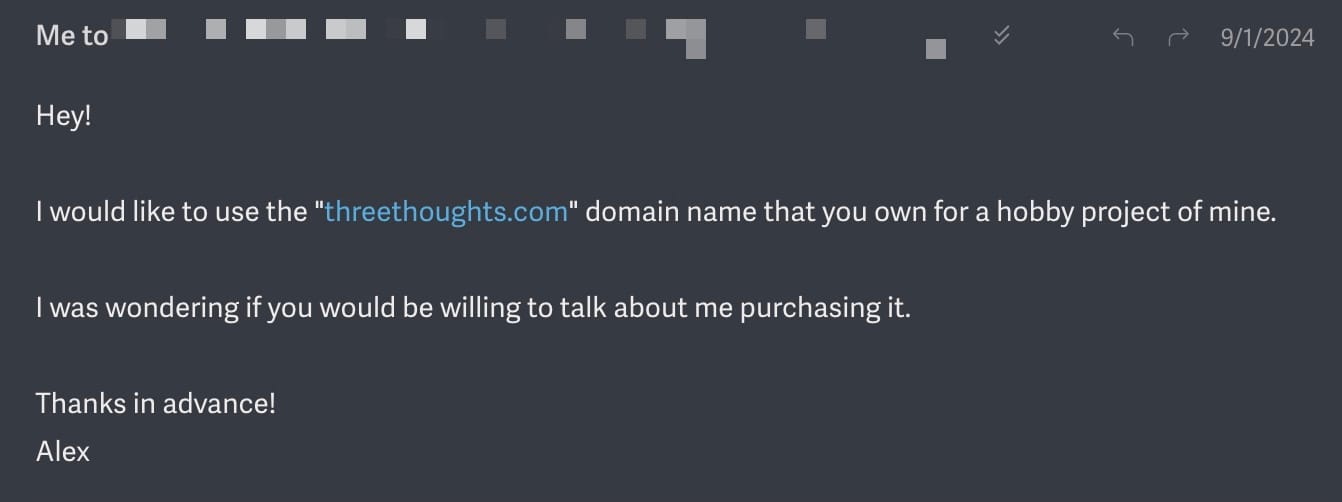
I didn't expect anything to come from it. Yet a day later, he emailed me back.
We spoke about our aspirations for the domain and more. I learned he is a professor and used his "three thoughts" concept when teaching creativity, while I shared the concept of this open journal you are reading.
In the end, I bought the domain from him and he shared this:

This new energy is a little overdue.
2 | "Nostalgia is memories minus the pain" - Derek Sivers
We hear a lot about following "your passion" to be successful. The phrase feels good, but has always felt a bit vague and misguided to me. Alex Hormozi (Hormozi from now on) in this video covers a lot of good points on the topic on why that is.
What stood out to me was how he characterizes many successful people tell their life story: with the rose-colored glasses we all have when looking back on fond memories. Like many a How I Built This podcast goes, we tend to gloss over the most difficult and ugly parts. About the uncertainty. The countless hours it took to get there. The sacrifices we had to make.
"Nostalgia is memories minus the pain."
The phrase felt familiar when he said it. I couldn't remember where I had heard it. I searched the phrase and opened Derek Siver's post "Here's How To Live: Make Memories."
I realized that I read this post when it came out, but it didn't stick with me at the time. It's an excellent post, but talks about nostalgia from a seemingly different context:
Nostalgia makes you more optimistic, more generous, more creative, and more empathetic.
Nostalgia is memories minus the pain.
The way Derek frames nostalgia feels novel to me. That it is something to cherish and to embrace, and be comfortable with a bit of revisionist history.
Your memories are a mix of fact and fiction.
...
Re-write your past.
...
Embellish adventures.
...
You have the right to reframe.
That didn't feel like the same way Hormozi talks about nostalgia at all!
Yet towards the end Derek says:
When you make a big mistake and want to learn its lesson, deliberately amplify the pain, the deep regret, and the consequences.
Keep the bad feelings vivid and visceral.
Make the lesson memorable, so you won’t do it again.
This is where it clicked for me. Nostalgia can be both a tool and curse depending on how you use it.
Hormozi emphasizes the negative effects for his purposes: how sharing a rosy view of your past, without proper context, can end up demotivating those who thought "following your passion" was the way to a fulfilling life.
Derek has a bit more nuance: how the memories and stories can help us live fulfilling lives, whatever the balance of fact vs. fiction.
But remember the important pains.
Internalize them.
Emphasize them.
Make those memories vivid.
So you don't repeat them.